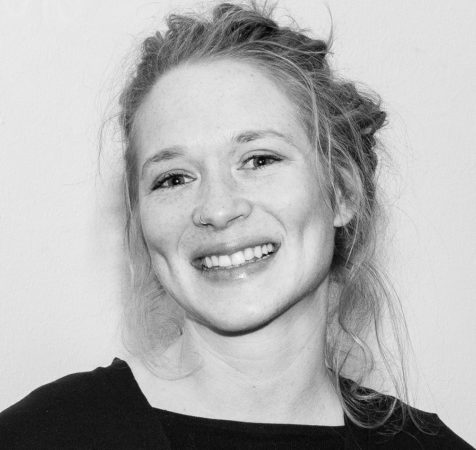
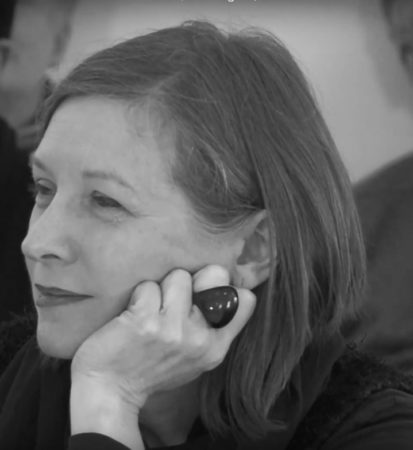
Ellen Remy received the main prize, endowed with 2,000 euros, for her project
“Society is the actor”.
The master’s thesis envisages the establishment of a cultural center with experimental and street theater at a run-down, unidentified transport hub in Stockholm, at the so-called “Slussen”. Based on the concept of liminality, which describes the state in which people gain cross-border experiences, she explores the special urban situation of this place in her master’s thesis and creates differentiated paths and interfaces with a hybrid structure of theater, cultural institution and transport infrastructure, enabling a controlled and casual exchange between passers-by and visitors to the cultural center.
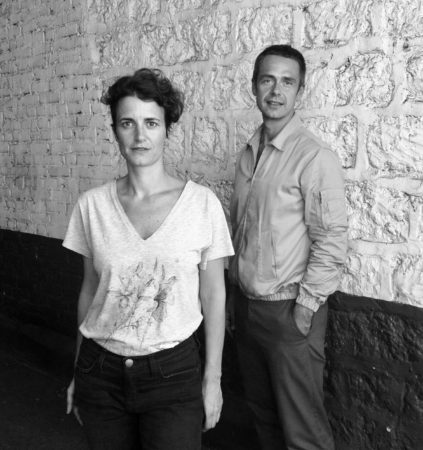
BRUTHER, established in Paris in 2007 by Stephanie Bru and Alexandre Thériot, has been doing exemplary work and represents a new approach amongst young architects in Europe to reigniting the legacy of the post-war European “welfare state”.
In Paris, as in many other large cities, young families, immigrants and students are increasingly being pushed further out into the suburbs. This is not solely attributable to the lack of affordable housing, but also to the shortfalls in public spending. City councils are struggling to fund the public services that were prevalent in the 1950’s and 60’s.
With their projects, many of which are designs for affordable housing with few minimum requirements, the two French designers Bruther have conquered new territory in the field of architectural design and redefined the notion of architecture as a collective good.
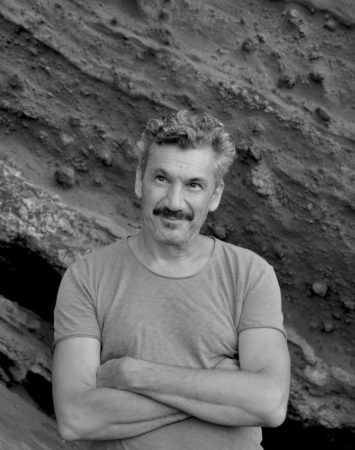
Antonas Office is considered internationally to be one of the most intellectually experienced players in the current debate on culture-critical theory development in today’s fragile Europe.
A major challenge in current discussions about architecture and cities is critical confrontation with the increasingly stronger neo-liberal occupation mechanisms in Europe. Aristide Antonas, Greek Architect and Philosopher, was one of the first people to examine this complex situation actively and ask about the potential, for instance by focusing on specific issues of social housing or the privatisation of public spaces in Greece.
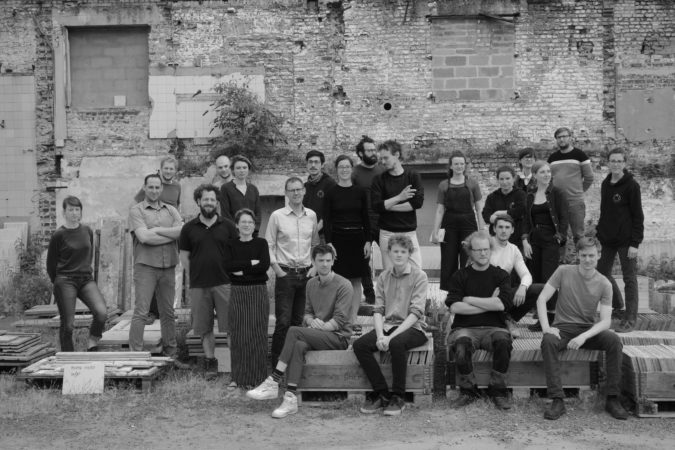
The Belgian collective Rotor, founded in 2005, is working on redesigning the use of materials in architecture and construction. It is often said that the great task of architecture in future is no longer in new construction, but in rebuilding and continuing construction. But what exactly does that mean and what consequences would this analysis have for the architectural discipline? No one has tested it so broadly and intensively in recent years as Rotor. As the name implies, it’s about cycles, specifically material cycles. Together with a lawyer they have developed a “Vademecum for the reuse of building materials”. The guide combines a close examination of the legal framework with the practical experience that the collective has gained over the years in the recycling of components.
Keller Easterling is researching in the way the spatial production of our living environment is logistically balanced and overlaid with technological developments. She pursues this on a very high theoretical and linguistic level without losing sight of the specific social dimension and political potential of urban space.
With “Enduring Innocence: Global Architecture and its Political Masquerades”she laid the theoretical foundation for a fresh yet critical view of the political gaps in the system of increasingly globalised architecture production. In “Extrastatecraft: The Power of Infrastructure Space” she examined the infrastructure network as a “community medium” and established ground-breaking points for the contemporary discussion on architecture and urban research.
Keller Easterling is considered to be one of the most important intellectual voices in the international discussion on architecture.
To provide the best experiences, we use technologies like cookies to store and/or access device information. Consenting to these technologies will allow us to process data such as browsing behavior or unique IDs on this site. Not consenting or withdrawing consent, may adversely affect certain features and functions.
Functional
Always active
The technical storage or access is strictly necessary for the legitimate purpose of enabling the use of a specific service explicitly requested by the subscriber or user, or for the sole purpose of carrying out the transmission of a communication over an electronic communications network.
Preferences
Technical storage or access is necessary for the legitimate purpose of storing preferences that have not been requested by the subscriber or user.
Statistics
Technical storage or access solely for statistical purposes.The technical storage or access that is used exclusively for anonymous statistical purposes. Without a subpoena, voluntary compliance on the part of your Internet Service Provider, or additional records from a third party, information stored or retrieved for this purpose alone cannot usually be used to identify you.
Marketing
The technical storage or access is required to create user profiles to send advertising, or to track the user on a website or across several websites for similar marketing purposes.